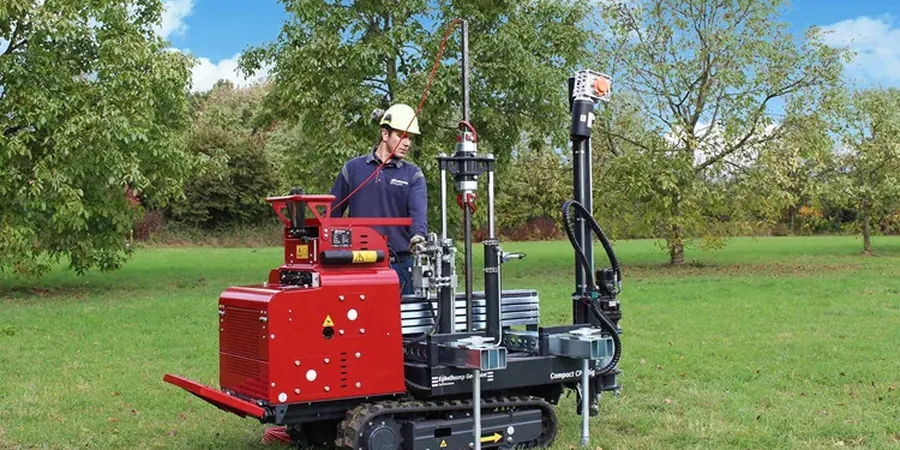
Indianapolis sits roughly 715 feet above sea level on a thick blanket of glacial drift deposited by multiple Wisconsin-age ice advances. The city’s subsurface rarely matches textbook assumptions: preconsolidated till can mask soft, normally consolidated silt lenses at 12 to 25 feet, and the White River floodplain introduces organic clays that standard SPT blow counts often misrepresent. For geotechnical engineers working within downtown IBC jurisdiction, the cone penetration test delivers continuous tip resistance, sleeve friction, and pore-pressure data that reveal these transitions before excavation or foundation design begins. Our CPT rig—a 20-ton truck-mounted unit with a 15 cm² electronic cone—pushes at a constant 2 cm/s rate, logging qc, fs, and u2 every 10 mm. The result is a high-resolution profile that distinguishes dense till from interbedded soft zones and feeds directly into pile capacity calculations for the city’s expanding near-eastside and downtown multi-story developments.
Continuous CPT soundings in Marion County glacial sequences detect soft seams thinner than 8 inches—features that split-spoon sampling routinely misses.
Methodology and scope
Local considerations
The freeze-thaw cycles that crack Indianapolis pavements from November through March also affect near-surface soil structure, creating a desiccated crust in fat clays that reads deceptively stiff on the friction ratio chart. If a CPT is pushed during a dry August week, the upper 5 feet can show qc values 30% higher than the same soil would yield in April after spring saturation. Our technicians note the weather window on every field log and correlate dissipation test results with recent rainfall records from the Indianapolis International Airport station. Another risk specific to the city’s glacial geology is gravel lenses within the Trafalgar Formation lodgement till: a cone encountering a 2-inch chert cobble at 30 feet can skew sleeve friction locally, producing a false positive for dense sand. We flag these spikes by running the Robertson (1990) soil behavior type classification with a moving-average filter and cross-checking against any nearby mud-rotary borings. In the White River corridor, a single CPT sounding that stops short of the bedrock surface can miss deeply weathered shale zones where end-bearing piles lose capacity; we routinely push to refusal when the structural load warrants it.
Applicable standards
ASTM D5778-20: Standard Test Method for Electronic Friction Cone and Piezocone Penetration Testing of Soils, IBC 2021 / Indiana Building Code (referencing ASCE 7-22 for seismic site class from Vs correlations), ISSMGE International Reference Test Procedure for CPT and CPTU (2012), Robertson & Cabal (2015) Guide to Cone Penetration Testing, 6th Edition
Associated technical services
Piezocone (CPTu) Investigation with Dissipation Testing
Full seismic site class determination via correlated Vs profiles, plus pore-pressure dissipation tests at target depths to estimate horizontal coefficient of consolidation (ch) in cohesive layers. Includes SBTn classification chart and normalized soil parameters per Robertson (2009).
CPT-Based Deep Foundation Design Package
Ultimate pile capacity calculations using LCPC (Bustamante & Gianeselli) and ICP-05 methods, delivered as side friction and end-bearing profiles per depth. Suitable for driven H-piles, closed-end pipe piles, and augered cast-in-place piles in Indianapolis till.
Typical parameters
Frequently asked questions
How deep can a CPT rig push in Indianapolis glacial till before refusal?
Our 20-ton truck-mounted rig typically reaches 50 to 80 feet in the lodgement till that underlies much of Marion County. Refusal is defined as a cone tip resistance exceeding 25 MPa sustained over 30 cm of penetration, or when the thrust capacity of the rig is reached. In areas near the White River where alluvial sands and gravels overlie the till, refusal may occur shallower if cobble-sized clasts are encountered.
Can CPT data replace soil borings for IBC foundation design in Indianapolis?
CPT provides continuous stratigraphic profiles and direct engineering parameters, but the IBC still requires soil samples for index testing (Atterberg limits, grain-size distribution) to classify soils and confirm corrosion potential. A common approach in Indianapolis is to combine CPT soundings with one or two mud-rotary borings at key locations—the CPT covers the spatial variability, and the borings supply the physical samples needed for laboratory compliance.
What does a CPT test cost for a typical Indianapolis commercial lot?
For a standard commercial lot investigation in Indianapolis, CPT soundings generally range from US$160 to US$240 per sounding, depending on depth, number of dissipation tests, and site access conditions. A full-day mobilization with five to eight soundings and real-time data processing is priced within that per-sounding range, with the final figure reflecting travel distance within Marion County and any traffic-control requirements.
How do you interpret CPT pore-pressure data in Indianapolis’s interbedded clays and silts?
We use the pore-pressure ratio Bq = (u2 – u0) / (qt – σv0) to identify drainage conditions during penetration. In the soft, normally consolidated silts found at 15 to 30 feet beneath the downtown area, Bq values above 0.4 indicate contractive behavior and potential for undrained strength degradation. We then run dissipation tests at those horizons to estimate the horizontal coefficient of consolidation (ch), which feeds into settlement-rate predictions and pile setup time estimates. More info.