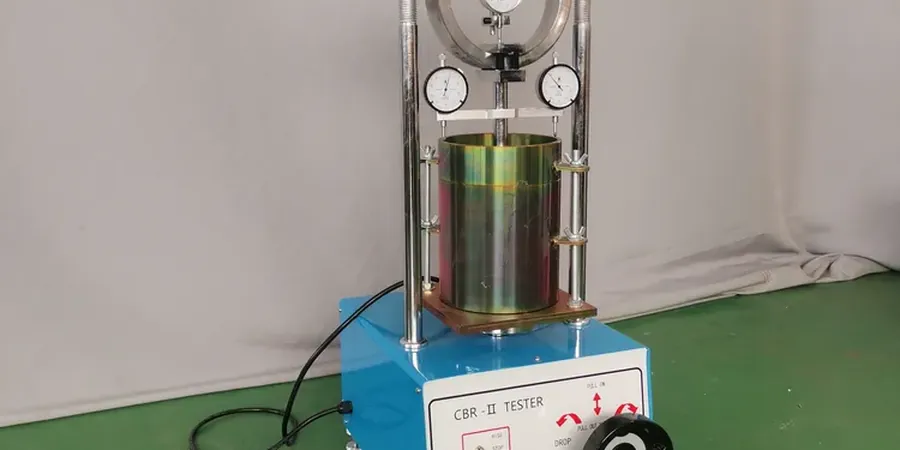
Pavement performance in Indianapolis depends heavily on what lies beneath the asphalt. AASHTO T-193 and ASTM D1883 govern the laboratory CBR test, and INDOT specifications reference CBR values as a direct input for flexible pavement thickness design. The city's glacial till deposits and occasional silty layers react to moisture in ways that standard compaction tests don't fully capture. A soaked CBR value measured in the lab tells engineers exactly how the subgrade will behave after spring rains saturate the upper soil profile. The Proctor test establishes the compaction target, but only the CBR test translates that density into a bearing capacity number that feeds directly into the AASHTO 93 pavement design equation. Getting this number wrong means either premature rutting or an overdesigned section that wastes budget.
Soaked CBR values below 6% in central Indiana subgrades demand either chemical stabilization or a thicker aggregate base to meet INDOT structural number requirements.
Local considerations
Highway expansion in Marion County during the 1960s and 70s reshaped the city's infrastructure footprint, but many of those pavements now sit on subgrades compacted without modern moisture control. The risk is straightforward: a subgrade that tests at CBR 8% in summer may drop below 4% after seasonal saturation. A laboratory CBR test with a 96-hour soak simulates that worst-case scenario. Projects near the White River and its tributaries face additional challenges from alluvial silts that lose strength dramatically when wet. Without a soaked CBR value, pavement designers are guessing, and the guess typically results in either premature fatigue cracking or unnecessary over-excavation. The lab test removes that uncertainty with a repeatable, standardized procedure that takes about five days from sample preparation to final load-penetration curve.
Applicable standards
ASTM D1883-21, AASHTO T-193-22, INDOT Section 207 Subgrade, ASTM D698-12 (compaction reference)
Associated technical services
Soaked CBR for INDOT Pavement Design
Full ASTM D1883 program with 3-point compaction, 96-hour soak, and penetration testing. We deliver the CBR value at 0.1-inch and 0.2-inch penetration along with the load-penetration curve. Ideal for new road construction and commercial developments requiring INDOT subgrade approval.
CBR with Swell Measurement and Moisture Control
Extended test protocol that tracks percent swell during the soaking period and correlates CBR with molding moisture content. Useful for sites with expansive clay components or where drainage improvements are being evaluated as a subgrade treatment strategy.
Typical parameters
Frequently asked questions
How long does a laboratory CBR test take in your Indianapolis lab?
Plan on five to seven business days from sample receipt to report. The compaction and setup take one day, the soaking period runs 96 hours as required by ASTM D1883, and the penetration test plus data reduction fills the remaining time. We can expedite if the project schedule demands it.
What CBR value does INDOT require for subgrade acceptance?
INDOT typically looks for a soaked CBR of at least 6% for standard subgrade conditions, though the exact threshold depends on the pavement design category and traffic loading. Values below 6% generally require either chemical stabilization with lime or cement, or an increase in the aggregate base thickness to compensate for the weaker subgrade.
How much does a laboratory CBR test cost for an Indianapolis project?
A single-point CBR test with compaction and 96-hour soak runs between US$140 and US$180 per specimen. A full 3-point curve (three specimens compacted at different moisture contents) provides the most design-relevant data and is priced accordingly based on the number of points requested.
Do you test remolded samples from the field or lab-compacted specimens?
We do both. For pavement design, the ASTM D1883 procedure uses lab-compacted specimens prepared at the target moisture and density from a Proctor curve. For forensic investigations of existing pavements, we can test undisturbed Shelby tube samples or remolded field material to evaluate what's actually in place.