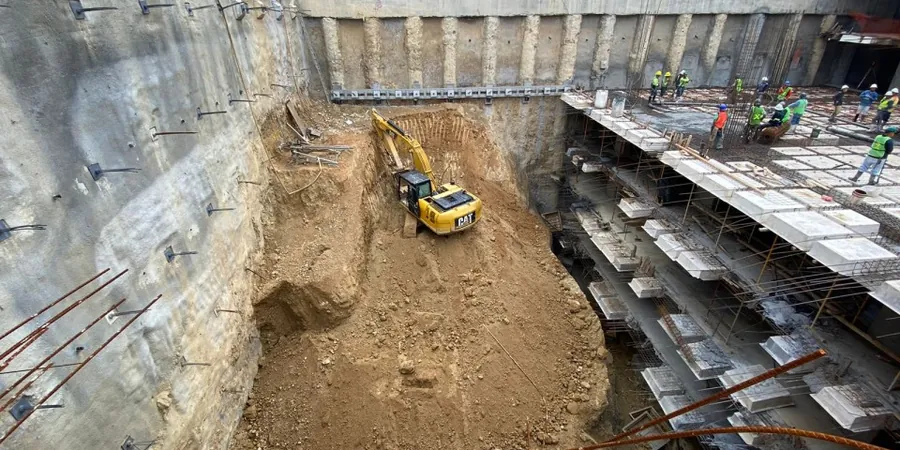
At 715 feet above sea level, Indianapolis sits on a buried bedrock valley filled with glacial till, outwash, and lake deposits. When an excavation goes deeper than 15 feet downtown, you are not just moving dirt — you are managing water-bearing sands and stiff clays that behave unpredictably under stress. Our team has worked on deep cuts along the White River corridor and near the Canal Walk, where the water table sits barely 8 to 10 feet below grade. A CPT test helps us map the transition from loose alluvium to dense till without losing resolution, while slope stability analysis becomes essential where adjacent structures limit the cut angle. The IBC and ASCE 7 govern lateral earth pressures and surcharge assumptions, but site-specific parameters from a carefully designed investigation make the difference between a shored excavation that holds and one that creeps.
In Indianapolis glacial stratigraphy, a 20-foot cut can expose three distinct hydrogeologic units — designing for just one is a recipe for blowout.
Methodology and scope
Local considerations
IBC Section 1806 and ASCE 7-22 Chapter 3 require that deep excavations be designed for the most critical combination of soil, surcharge, water, and seismic loads. Indianapolis falls in Seismic Design Category A or B, so inertial effects are low, but liquefaction of loose sand lenses within the till is not zero risk — we check it with SPT-based procedures when the excavation extends below the water table. The bigger hazard here is hydraulic instability. A sand seam connecting the excavation face to a recharge source can trigger quick conditions or piping, undermining adjacent foundations before any warning signs appear. We require observation wells and piezometers to track the phreatic surface throughout construction. If the data diverge from the design assumptions, we adjust the dewatering plan or increase the embedment depth of the wall. No design leaves our office without a contractor-friendly monitoring table that ties trigger levels to specific response actions.
Applicable standards
IBC 2021 Section 1806 — Presumptive and design lateral earth pressures, ASCE 7-22 Chapter 3 — Load combinations including lateral soil and hydrostatic pressures, ASTM D1586-18 — Standard Penetration Test for liquefaction screening in sand lenses, FHWA GEC No. 4 — Ground Anchors and Anchored Systems, NAVFAC DM 7.02 — Foundation and Earth Structures for dewatering and slope stability, ASTM D2487-17 — Classification of glacial soils for engineering purposes
Associated technical services
Bracing and tieback analysis
We design internal bracing layouts and grouted tieback anchors for cuts up to 60 feet. Each anchor bond zone is verified against the actual soil stratigraphy — we reject generic bond stress assumptions and require pullout tests on production anchors.
Construction dewatering and cutoff wall design
Our team develops groundwater control plans using analytical and numerical models. For sites near the White River or Fall Creek, we design cutoff walls and deep well arrays that prevent drawdown-induced settlement of neighboring structures.
Typical parameters
Frequently asked questions
How deep can you excavate in downtown Indianapolis without underpinning adjacent buildings?
There is no universal depth threshold. It depends on the setback, the foundation type of the adjacent structure, and the soil stratigraphy at the specific block. Under IBC, you must demonstrate that the zone of influence — typically 1.5 to 2.5 times the excavation depth — does not induce angular distortion exceeding 1/500 for framed buildings. We use finite element settlement analysis to make that determination.
What is the cost range for a geotechnical excavation design in Indianapolis?
For a design package covering soil investigation review, lateral earth pressure calculations, bracing or tieback design, dewatering analysis, and construction-phase monitoring specifications, costs typically range from US$1,850 for a single-family basement cut to US$7,190 for a multi-level commercial excavation with complex adjacent structures.
Do I need a dewatering permit for a deep excavation in Marion County?
Yes, if you are discharging groundwater to the municipal storm sewer or a surface water body. Marion County requires an NPDES construction stormwater permit, and the Indianapolis Department of Public Works must approve the dewatering discharge plan. Our design package includes the flow rate calculations and treatment specifications you need for the permit application.
Can you design an excavation support system that eliminates rakers and internal bracing?
In many Indianapolis soils, yes. We frequently design tied-back soldier pile and lagging walls or secant pile walls with prestressed ground anchors that keep the excavation completely open. The feasibility depends on available easements and the presence of sand lenses that reduce bond stress. We always require on-site anchor testing to confirm capacity.