The freeze-thaw cycles in Indianapolis punish unprepared soil. Come February, the ground heaves and shrinks, turning loose granular fill into a structural gamble. That's why vibrocompaction design isn't just a line item here—it's the foundation of any project that touches glacial outwash or urban fill. Our team has spent years correlating SPT blow counts from downtown Indianapolis borings with post-treatment cone resistance, building a dataset that predicts densification radius block by block. The White River basin left behind layered sands and silts that compact unevenly under static load, and we've seen the cost of ignoring that: differential settlement cracking floor slabs in Broad Ripple warehouses and tilting approach ramps near the I-465 interchange. A proper subsurface investigation with SPT is the first step before any vibro design, giving us the baseline N-values that dictate probe spacing and vibration energy. Indianapolis demands this level of upfront rigor, and we deliver it.
In Indianapolis glacial outwash, a 10-foot probe spacing can mean the difference between 2% settlement and zero settlement over 20 years.
Methodology and scope
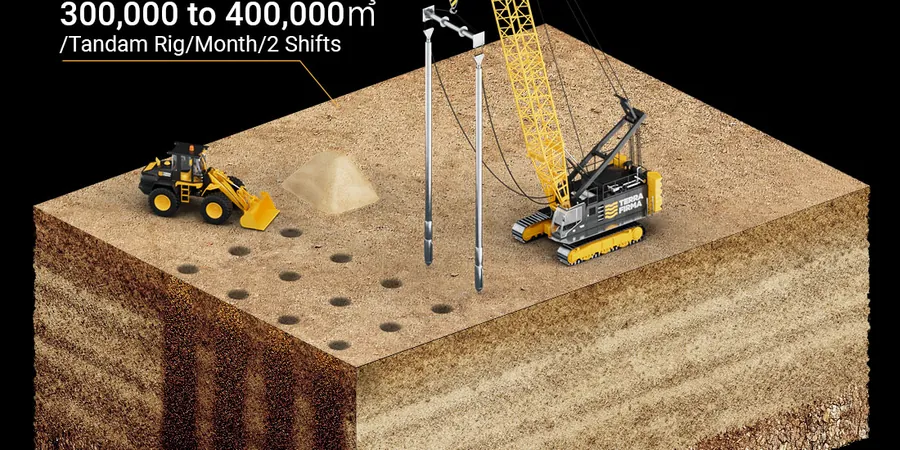
Local considerations
We've pulled post-treatment CPT logs in Indianapolis where the tip resistance jumped from 40 tsf to over 120 tsf in the top 25 feet, yet a 30-foot zone of silty sand below showed almost no improvement. That's the trap. The vibro probe hits a layer with 18% fines, the pore pressure spikes, and the energy dissipates into water instead of re-arranging grain contacts. We catch this early by running pre-design in-situ permeability tests and correlating them with grain-size curves. If the coefficient of permeability drops below 10^-4 cm/s, we know the soil won't drain fast enough during vibration. The fix might be pre-drilling drainage paths, reducing probe spacing, or switching to stone columns in the marginal zones. Ignoring this stratification risk leaves soft pockets that consolidate slowly under foundation load, creating differential settlement years after the building is occupied. In Indianapolis, where mixed alluvial deposits are the rule, not the exception, we design with this reality in every cross-section.
Applicable standards
IBC 2021 Chapter 18 (Soils and Foundations), ASCE 7-22 Section 12.13 (Foundation Design Requirements), ASTM D1586-18 (Standard Penetration Test), ASTM D4253/D4254 (Maximum and Minimum Index Density of Soils), FHWA-NHI-16-072 (Ground Improvement Methods)
Associated technical services
Pre-Treatment Site Characterization
We review existing borings or execute new SPT/CPT campaigns to map the depth, thickness, and grain-size distribution of targetable loose sand layers across your Indianapolis site.
Vibrocompaction Grid & Energy Specification
We calculate probe spacing, vibrator power, and dwell time per depth increment based on your soil's relative density goal and fines content, delivered as a ready-to-bid plan set.
Liquefaction Mitigation Design
For sites in Seismic Design Category C or higher, we perform cyclic stress ratio analysis and specify densification targets that eliminate liquefaction potential under the design earthquake.
Post-Treatment Verification Testing
We design and manage CPT or SPT verification programs, comparing pre- and post-treatment data to confirm minimum relative density and settlement criteria are met per IBC acceptance protocols.
Typical parameters
Frequently asked questions
How much does vibrocompaction design cost for a typical Indianapolis commercial lot?
For a standard commercial lot in Indianapolis—roughly 1 to 3 acres with loose sands extending to 40 feet—the design package typically runs between US$1,450 and US$5,430. The range depends on the number of borings we need to interpret, the complexity of the stratification, and whether liquefaction analysis is required per IBC. A simple warehouse pad with uniform sand falls on the lower end. A multi-story building with variable fill and a Seismic Design Category D classification pushes toward the upper end.
What soil types in Indianapolis respond best to vibrocompaction?
Clean sands with less than 12% fines and gravelly sands densify best. Much of the glacial outwash along the White River corridor in Indianapolis fits this profile. Silty sands with 12 to 18% fines can still be treated but require closer probe spacing and lower frequency. Soils with more than 20% fines or significant clay content won't densify effectively through vibration alone—those zones need stone columns or rigid inclusions instead.
How deep can vibrocompaction reach in Indianapolis glacial deposits?
We routinely design treatment to depths of 65 feet, which covers most loose sand layers encountered in Marion County. The limiting factor is the vibrator mast length and the presence of a competent bearing layer below the target zone. In some near-downtown Indianapolis borings, we hit dense till at 50 to 60 feet, which provides a natural refusal surface and an excellent foundation for the densified column above.
What post-treatment testing do you require to sign off on the compaction?
We specify either CPT soundings or SPT borings at a rate of at least one test per 2,500 square feet of treated area, with a minimum of three tests per site. The acceptance criteria tie directly to your project's relative density target—typically 70% or higher. We compare pre- and post-treatment tip resistance or N-values and issue a stamped report confirming the ground improvement meets the IBC bearing and settlement requirements for your Indianapolis building permit.