One of the most persistent errors we encounter in Indianapolis is the assumption that liquefaction is only a West Coast or New Madrid problem. Engineers unfamiliar with the local geology often skip the cyclic stress ratio evaluation entirely, only to face costly redesigns when the IBC-mandated site-specific analysis reveals loose saturated sand lenses within the glacial outwash. Our technical team has reviewed dozens of geotechnical reports across Marion County and beyond, and the pattern is clear: standard boring logs without SPT energy corrections and grain-size distribution curves are insufficient to rule out the hazard. When a project near the White River or Fall Creek encounters a water table within 15 feet of grade, the potential for flow failure is real. We approach every soil liquefaction analysis with the NCEER (Youd & Idriss, 2001) framework, integrating corrected N-values and fines content to calculate the factor of safety against triggering. This is not a generic desktop review; it is a field-verified, laboratory-supported evaluation tailored to Indiana's Pleistocene stratigraphy, often supplemented by grain-size distribution tests to refine the liquefaction susceptibility classification.
Liquefaction in Indiana is not a theoretical risk; it is a stratigraphic condition that demands corrected blow counts and fines content data for defensible design.
Methodology and scope
Local considerations
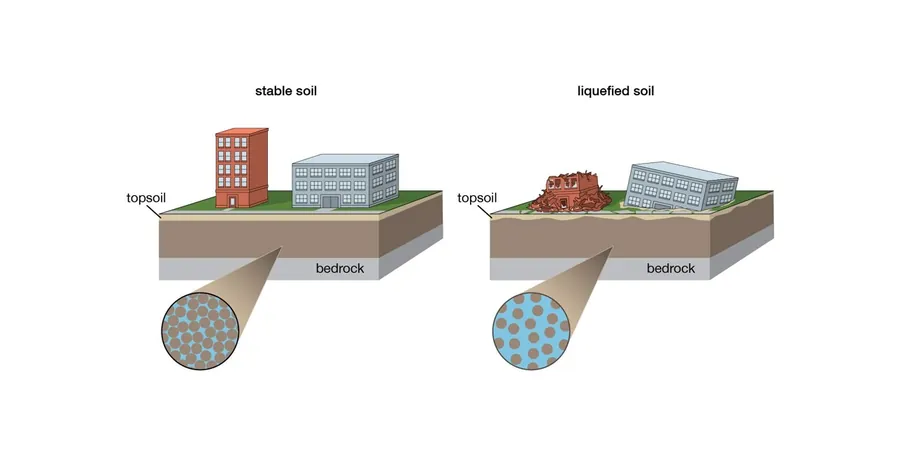
The seasonal fluctuations of the White River and the perched groundwater tables typical of Indianapolis's glacial geology create a distinct risk profile that a dry-season investigation can easily miss. The moisture held in the upper silty clays during spring months can obscure a freely draining sand layer below until excavation or boring reveals a rapid water inflow. In a seismic event, that confined aquifer-like condition amplifies the generation of excess pore water pressure, and without adequate drainage paths, the sand loses effective stress quickly. The consequence is differential settlement that can fracture slab-on-grade foundations and sever underground utilities. We have observed this mechanism in post-construction failure analyses where a slope stability assessment was performed but the liquefaction potential was dismissed based on an incomplete SPT dataset. Our approach mandates sampling at every change in lithology and at intervals not exceeding 2.5 feet within potentially liquefiable strata, a practice that goes beyond the minimum ASTM D1586 standard and is essential for reliable cyclic resistance ratio calculation.
Explanatory video
Applicable standards
ASCE 7-22 Chapter 20: Site-Specific Ground Motion Procedures, NCEER Workshop (Youd & Idriss, 2001): Summary of SPT-Based Liquefaction Evaluation, ASTM D1586-18: Standard Test Method for SPT and Split-Barrel Sampling, ASTM D2487-17: Classification of Soils for Engineering Purposes (USCS), IBC 2021 Section 1613: Earthquake Loads
Associated technical services
SPT-Based Liquefaction Triggering Analysis
Execution of standard penetration tests with hammer energy calibration and mud-rotary drilling to sample the full depth of the liquefiable column. We calculate the cyclic stress ratio and cyclic resistance ratio for each borehole, delivering a factor of safety profile and a post-triggering settlement estimate suitable for inclusion in the geotechnical baseline report.
Integrated Site Response and Liquefaction Deformation Study
For Indianapolis projects classified as Risk Category III or IV, we couple one-dimensional equivalent-linear site response analysis with the liquefaction assessment to capture the effect of local soil amplification. The output includes lateral spreading displacement and vertical settlement maps that inform foundation type selection and ground improvement design.
Typical parameters
Frequently asked questions
What is the cost of a soil liquefaction analysis for a commercial building site in Indianapolis?
For a typical commercial lot in Indianapolis requiring two boreholes with SPT sampling at close intervals and laboratory grain-size testing, the fee ranges from US$2,420 to US$4,260. The final cost depends on the depth to refusal, the number of samples requiring fines content determination, and whether a CPT sounding is added to refine the stratigraphy.
Does the IBC require a liquefaction study for every project in Indianapolis?
The IBC requires a site-specific evaluation if the mapped spectral accelerations and the subsurface profile trigger the screening criteria. Even when the USGS liquefaction hazard map suggests low susceptibility, the presence of loose saturated sand in a borehole log can override the default classification and require a cyclic stress analysis to satisfy the building official.
How deep do you typically drill to evaluate liquefaction potential in Central Indiana?
We extend the investigation to at least 50 feet below grade, or to the depth where N-values consistently exceed 30 blows per foot in a known non-liquefiable stratum such as the lodgment till. The NCEER protocol requires evaluating all sand layers within the upper 50 feet that are below the groundwater table, a depth that captures the full thickness of the glacial outwash in Marion County.
Can you use existing SPT data from a previous geotechnical investigation for the liquefaction analysis?
Existing SPT data can serve as a starting point only if the hammer energy ratio was measured and the drilling method is documented. Without an energy-corrected N60 value, the factor of safety calculation is unreliable. We typically recommend a supplemental boring with calibrated equipment to validate the legacy data before proceeding with the NCEER evaluation.