Road Geotechnics in Indianapolis addresses the interaction between pavement structures and the underlying glacial till and outwash soils typical of Marion County. Local practice follows AASHTO guidelines and INDOT specifications, where subgrade stabilization often governs long-term performance. Our flexible pavement design accounts for freeze-thaw cycles and expansive clay pockets, while CBR study for road design quantifies bearing capacity to calibrate layer thicknesses against traffic loads.
These geotechnical investigations support arterial rehabilitations, subdivision streets, and industrial access roads where soft subgrades or poor drainage demand engineered solutions. For concrete applications under heavy trucking or intersection loading, we complement the assessment with rigid pavement design that relies on modulus of subgrade reaction derived from field testing.
Tieback capacity in glacial till depends more on installation method and grout injection pressure than on the raw undrained shear strength of the soil.
Methodology and scope
Local considerations
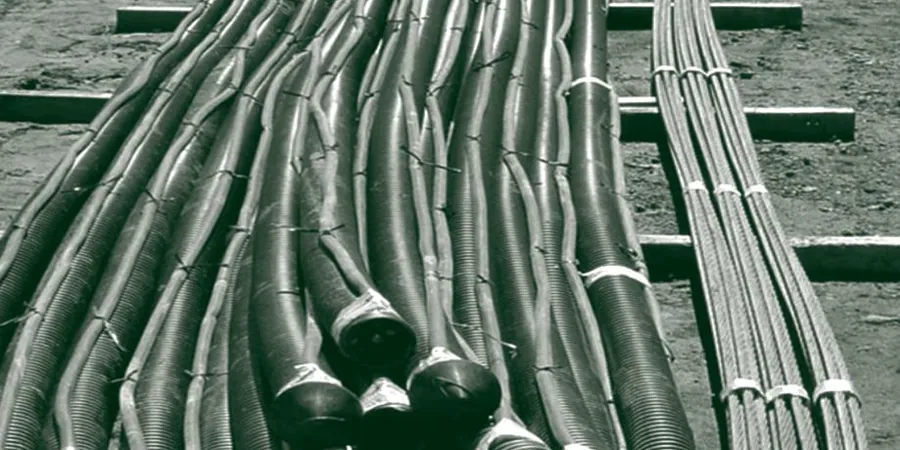
Indianapolis grew outward from the Mile Square plat of 1821, and much of the downtown infrastructure was laid over a century ago without modern geotechnical records. Excavating next to unreinforced masonry buildings from the early 1900s introduces a risk that passive anchors in the weathered till zone might creep under sustained load if the bond stress is set too high. The most common failure mode we observe in forensic reviews is progressive debonding in the fixed length due to inadequate grout coverage against the borehole wall. In the Fall Creek and Pleasant Run valleys, alluvial deposits with decaying organics create an environment where groundwater chemistry can accelerate corrosion of unprotected steel. Our anchor designs for permanent installations in these settings always include electrically isolated tendons and a minimum 0.5-inch grout cover inside corrugated HDPE sheathing. We also require lift-off testing on 5% of production anchors to validate the lock-off load hasn't relaxed over time, a practice that has caught underperforming anchors before they became a problem on several downtown projects.
Applicable standards
PTI DC35.1-14 Recommendations for Prestressed Rock and Soil Anchors, IBC Chapter 18 Soils and Foundations — Section 1807 Earth-Retaining Systems, ASTM A416/A416M-18 Standard Specification for Low-Relaxation, Seven-Wire Steel Strand, ASTM C109/C109M-21 Standard Test Method for Compressive Strength of Hydraulic Cement Mortars, FHWA-NHI-10-016 Drilled Shafts and Earth Retaining Structures
Associated technical services
Active Anchor Design and Load Testing
Complete design package for post-tensioned tieback anchors including bond length calculation in till and limestone, free length determination behind the active wedge, corrosion protection detailing per PTI Class I or II, stressing sequence, and on-site proof testing with hydraulic jack and dial gauge monitoring. We handle anchor layouts for soldier pile walls, secant pile walls, and mat foundation hold-down applications.
Passive Anchor and Soil Nail Systems
Design of fully grouted passive anchors and soil nails for slope reinforcement and retaining wall stabilization in weathered till and outwash deposits. Includes nail spacing optimization, facing design coordination, and sacrificial nail pull-out testing to verify bond strength before production installation. Frequent application along White River Parkway and Fall Creek corridor.
Typical parameters
Frequently asked questions
What distinguishes an active anchor from a passive anchor in retaining wall design?
Active anchors are post-tensioned after grouting, applying a lock-off load that actively compresses the retained soil mass. Passive anchors rely on soil deformation to develop resistance. In Indianapolis glacial till, active systems are preferred for deep urban cuts where adjacent settlement must be limited, while passive soil nails work well for cut slopes along highway widenings where some lateral movement is acceptable.
How much does anchor design and testing cost for a typical Indianapolis project?
Engineering design and load testing services for a small to medium anchor program generally range from US$1,010 to US$4,000 depending on the number of anchors, the complexity of the corrosion protection required, and whether sacrificial testing anchors are included in the program. A detailed proposal follows a site visit and review of the geotechnical report.
What drill methods work best for anchor installation in glacial till with cobbles?
Duplex drilling with an eccentric bit handles cobbles and boulders well without losing the hole. In stiff, intact till without large obstructions, rotary open-hole drilling can be faster and produces less smear on the borehole wall, which improves the bond strength. The method should always be confirmed with a test anchor on site before production begins.
How do you verify an anchor is performing correctly after installation?
We specify a proof testing program following PTI DC35.1, where each production anchor is loaded incrementally to 133% of the design load while monitoring creep rate with a dial gauge. For permanent anchors, we also recommend lift-off testing on a representative sample at 7 and 28 days to confirm the lock-off load hasn't relaxed. Documentation goes into the project record before the excavation proceeds below the anchor level.