Tunneling beneath Indianapolis means confronting two very different subsurface personalities. North of Fall Creek, you are often cutting through dense, overconsolidated glacial till left by the Wisconsin ice sheet — stiff, silty clay with scattered cobbles that can hold a face reasonably well. But shift south toward the White River floodplain, and the profile changes completely: soft alluvial silts, loose sands, and organics that deform under even modest face pressure. That contrast, sometimes within the same project alignment, is why a one-size-fits-all approach to soft ground tunneling rarely works here. Our team pulls Shelby tube samples from the transition zones, runs UU and CIU triaxial on the soft layers, and cross-checks the undrained shear strength against CPT pore pressure dissipation tests. The goal is a ground model that captures not just the average conditions, but the sharp transitions that can stall a TBM or cause unexpected settlement at the surface.
In Indianapolis, the biggest risk to a soft-ground tunnel is not the soft soil itself — it is the abrupt transition from stiff till to compressible alluvium that goes undetected.
Methodology and scope
Local considerations
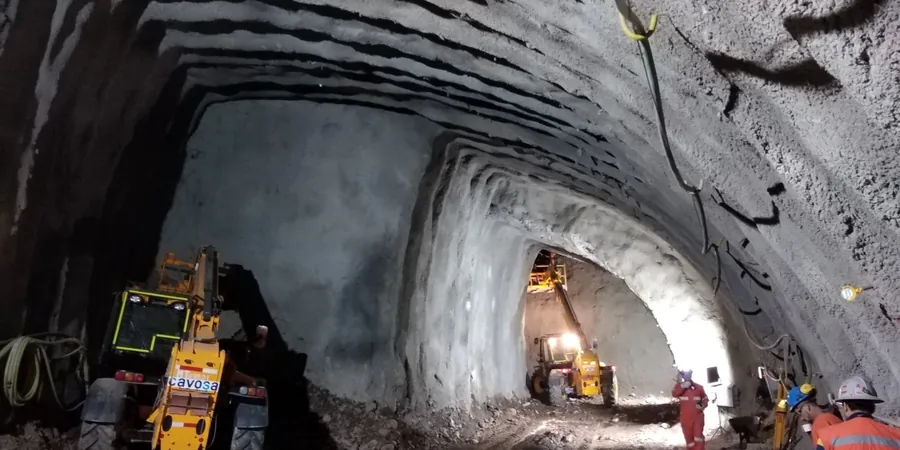
The pre-Illinoian glacial deposits that underlie much of Indianapolis contain discontinuous sand lenses and cobble layers that act as confined aquifers. When a tunnel drive intersects one of these lenses, the inflow can be sudden and erosive, washing fines out of the face and creating voids behind the lining. We have seen this pattern repeatedly in deep excavations near the White River, where a layer of clean sand no more than 2 feet thick produced flows exceeding 50 gpm until grouted. The second risk, less obvious but equally damaging, is long-term consolidation settlement under the tunnel invert in the soft alluvial clays south of downtown. Even with a fully lined tunnel, the compressible soils at depth can continue to consolidate for years under the permanent load, gradually affecting utilities and structures above. We address this with incremental loading oedometer tests and coupled flow-deformation analyses that project settlement over a 50-year design life.
Applicable standards
ASTM D1586-18 (Standard Test Method for Standard Penetration Test), ASTM D4767-11 (Consolidated Undrained Triaxial Compression Test), ASTM D2435/D2435M-11 (One-Dimensional Consolidation Properties of Soils), ASCE/SEI 7-22 (Minimum Design Loads for Buildings and Other Structures), IBC 2021/2024 Chapter 18 (Soils and Foundations)
Associated technical services
Geotechnical Baseline Report (GBR)
We compile site-specific stratigraphy, groundwater data, and engineering parameters into a defensible baseline that establishes the contractual ground conditions for tunnel bidding and construction.
Pre-Construction Soil Characterization
Combining SPT borings, CPT soundings, and Shelby tube sampling to define the boundaries between glacial till, alluvial soft clays, and outwash sands along the proposed alignment.
Tunnel Face Stability Analysis
Limit-equilibrium and finite-element assessments of face support pressure requirements in soft, saturated soils, accounting for the layered stratigraphy common in the Indianapolis area.
Settlement and Ground Movement Prediction
Empirical and numerical estimates of surface settlement troughs, volume loss, and building distortion, using parameters derived from local consolidation and triaxial test programs.
Typical parameters
Frequently asked questions
What makes Indianapolis soils challenging for soft-ground tunneling?
The main challenge is the abrupt transition from stiff glacial till in the northern part of the city to soft, compressible alluvial soils along the White River floodplain. These soft soils have low undrained shear strength — often below 800 psf — and are saturated, which makes face stability difficult. Add to that a shallow water table that fluctuates several feet with the seasons, and you get a ground profile that can change dramatically within a short distance.
What investigation methods do you use for tunnel design in soft soils?
We use a combination of SPT borings for stratigraphy, CPT soundings for continuous strength and pore pressure profiles, and Shelby tube sampling for laboratory testing. In the lab, we run triaxial (UU and CIU), consolidation, and permeability tests on the soft layers. For the till, we focus on grain size analysis and undrained strength. MASW or seismic refraction may be added to map bedrock depth when the tunnel alignment is deep.
How much does geotechnical analysis for a soft-ground tunnel cost in Indianapolis?
A comprehensive geotechnical investigation for a soft-ground tunnel in Indianapolis typically ranges from US$3,690 for a small-scale preliminary study to US$18,660 for a full program involving deep borings, CPT soundings, sophisticated laboratory testing, and numerical modeling. The final cost depends on the length of the alignment, the number of investigation points, and the complexity of the ground conditions.