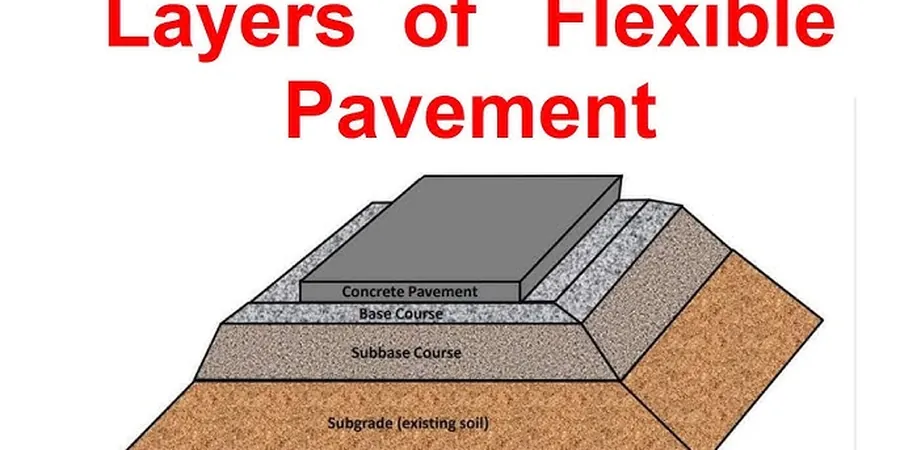
Indianapolis sits on a mix of glacial till and outwash deposits that demand a precise flexible pavement design strategy. Winter temperatures here routinely drop below 20 degrees Fahrenheit, and the freeze-thaw cycling can tear apart an under-designed asphalt section in two seasons. We focus on the subgrade first. A pavement is only as good as the soil beneath it, so we run CBR testing to nail down the bearing capacity before selecting layer thicknesses. The city’s 37-inch average annual rainfall also means drainage has to be designed into the structural section—standing water in the base course is a guaranteed failure mechanism. Our lab works with local INDOT specifications and the AASHTO 93 design method to produce pavement structures that handle Marion County’s traffic loads without rutting or fatigue cracking.
An Indianapolis pavement fails from the bottom up. Subgrade stiffness and frost protection are the two numbers that matter most.
Methodology and scope
Local considerations
Sites near the White River floodplain and those up on the Tipton Till Plain perform completely differently under pavement loading. A project in Broad Ripple might hit sand and gravel at three feet, while a site in Warren Township could be dealing with six feet of high-plasticity clay that heaves in January and softens in April. That’s why we never copy-paste a pavement design across Indianapolis neighborhoods. We sample the subgrade at the exact station and offset where the pavement will sit. The biggest risk we see is owners skipping the resilient modulus test and using an assumed CBR from a visual classification—that shortcut leads to either overbuilt sections that waste money or underbuilt sections that rut before the first warranty inspection.
Applicable standards
AASHTO Guide for Design of Pavement Structures (1993), ASTM D1883: CBR of Laboratory-Compacted Soils, ASTM D1557: Modified Proctor Compaction, INDOT Standard Specifications Section 302
Associated technical services
Subgrade Resilient Modulus
Repeated load triaxial testing per AASHTO T 307 to determine Mr values for AASHTO 93 design inputs.
CBR Laboratory Testing
California Bearing Ratio on soaked and unsoaked samples to evaluate subgrade and base course strength under saturated conditions.
Compaction Control
Modified Proctor curves plus field density verification with nuclear gauge or sand cone for INDOT acceptance.
Pavement Structural Design
Layer thickness and material recommendations using AASHTO 93 equations, including frost protection depth checks for Indianapolis.
Typical parameters
Frequently asked questions
What’s the typical cost for a flexible pavement design package in Indianapolis?
For a standard commercial lot or short roadway segment, our pavement design packages run between US$1,680 and US$4,640. The final number depends on how many subgrade borings we need and whether we’re testing base aggregate durability or just subgrade stiffness.
How do Indianapolis freeze-thaw cycles affect flexible pavement?
Water expands about 9% when it freezes. If your subgrade is frost-susceptible silt or clay, the heave lifts the asphalt, then spring thaw leaves a weakened, saturated base that ruts under traffic. Our designs include a frost protection layer—either additional aggregate base or a select fill—to keep the frost line out of the subgrade.
What traffic loads do you design for?
We use the AASHTO 93 ESAL (Equivalent Single Axle Load) method. You give us the ADT and truck percentage, and we calculate the 20-year ESAL forecast. For industrial lots with heavy forklift traffic, we can also run a layered elastic analysis if the AASHTO empirical equations don’t capture concentrated wheel loads.
How long does lab testing take?
CBR and Proctor results are typically ready in 5 to 7 business days after we receive the samples. Resilient modulus testing adds about three extra days because of the conditioning cycles required by AASHTO T 307. We can expedite if the contractor is waiting to mobilize.