The difference between a stable subgrade in Broad Ripple and settlement issues near the White River often comes down to one factor: compaction control. Indianapolis sits on a complex mix of glacial till, outwash sands, and silty clays deposited during the Wisconsin glaciation, and the moisture-density behavior of these materials shifts dramatically from one neighborhood to the next. A test pit investigation on the north side might reveal stiff, overconsolidated till that compacts predictably, while fill soils in the old Near Eastside industrial corridors can behave erratically under load. Our Proctor testing program establishes the laboratory benchmark—maximum dry density and optimum moisture content—so field compaction crews know exactly what target to hit, whether the spec calls for Standard effort (ASTM D698) or Modified effort (ASTM D1557) for heavier structural loads.
A Proctor number without knowing the soil's grain-size distribution is just a number—the real value comes from pairing it with a classification that explains why the curve looks the way it does.
Methodology and scope
Local considerations
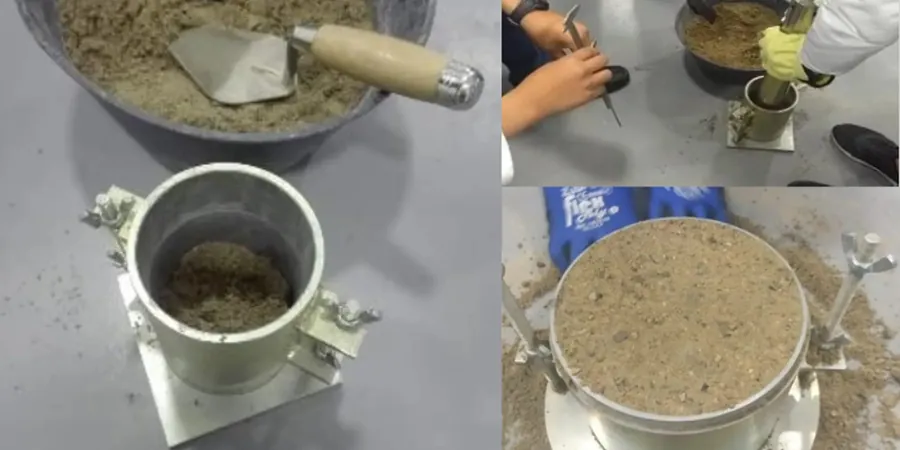
The mechanical hammer on our automatic Proctor compactor delivers a consistent 5.5-lb or 10-lb drop across all five lifts, which eliminates the operator variability that can skew results when done manually—a critical detail when you are testing borderline moisture-sensitive Indianapolis till. The real risk we catch in the lab is a flat, poorly defined curve: when the soil does not show a clear density peak, it often signals that the material is gap-graded or contains too much silt, and field compaction will be unforgiving. In those cases we run a one-point Proctor or recommend a triaxial shear test to evaluate whether the material is even suitable as structural fill. Skipping the Proctor entirely because the soil looks fine is how you end up with differential settlement under a slab on the south side, where pockets of low-density fill went unnoticed until the cracks appeared.
Applicable standards
ASTM D698-12 (Standard Proctor), ASTM D1557-12 (Modified Proctor), ASTM D2487-17 (Soil Classification), INDOT Standard Specifications Section 203
Associated technical services
Standard Proctor (ASTM D698)
Lower compactive effort suitable for shallow residential footings, landscape berms, and utility trench backfill where the specification matches the standard energy level. We test the exact borrow source you plan to use.
Modified Proctor (ASTM D1557)
Higher energy compaction for commercial building pads, roadway subgrade, and structural fill under heavy floor loads. Matches the output of modern vibratory rollers and sheepsfoot compactors used on Indianapolis commercial sites.
Typical parameters
Frequently asked questions
What does a Proctor test cost in Indianapolis?
Standard Proctor (ASTM D698) runs US$100–$150 per sample, and Modified Proctor (ASTM D1557) runs US$150–$220. The price depends on the number of points we run on the curve and whether the soil requires pre-treatment like drying or sieving. For most commercial jobs, we batch samples to keep the per-unit cost down.
How long does it take to get results?
A single Proctor curve runs about 24 hours from sample drop-off to a signed report, because the soil has to be oven-dried, processed, and compacted at multiple moisture contents. Same-day turnaround is possible with advance notice if the material is straightforward.
Which Proctor method do I need for an Indianapolis parking lot?
Most parking lots in Marion County are spec'd under Modified Proctor (ASTM D1557), especially when the pavement section includes asphalt or concrete over aggregate base. The heavier compactive effort reflects the energy of the rollers used on site. For gravel-only overflow lots, Standard Proctor may be acceptable per the geotechnical report.
Can you test material that has oversize particles?
Yes. When the fill contains more than 10% material retained on the 3/4-inch sieve, we run the oversize correction per ASTM D4718. We scalp out the coarse fraction, compact the fines in the mold, and mathematically correct the curve to account for the rock volume. This is common with crushed-stone base courses used throughout Indianapolis.