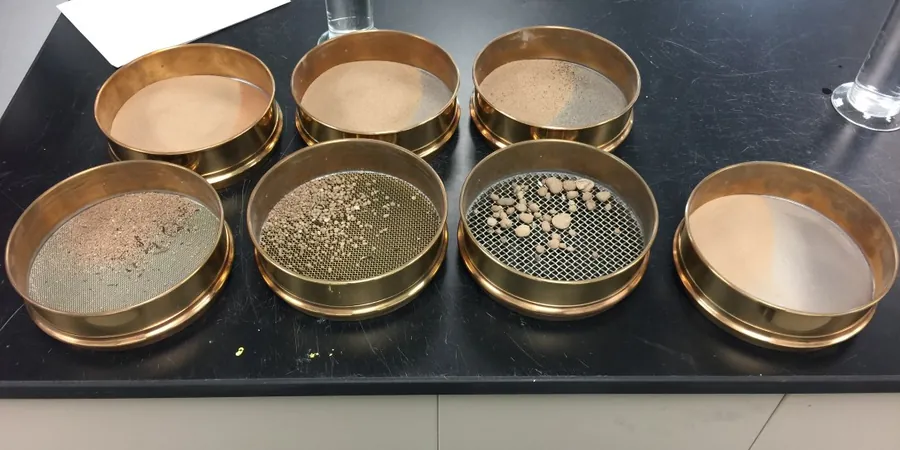
When a set of brass sieves arrives on a project site in Indianapolis, stacked from 3 inches down to the No. 200 mesh, and the laboratory hydrometer is already settling in a temperature-controlled cylinder, you know the subsurface investigation is getting serious. That combination of mechanical shaking and sedimentation analysis is how we separate gravel from sand, and silt from clay, inside the glacial till and outwash deposits that define the geology beneath Marion County. Indianapolis sits on the Tipton Till Plain, where the Wisconsin glaciation left a layered mix ranging from well-drained sand lenses to fat clays with swelling potential. Understanding the exact particle distribution is not academic. It directly controls compaction requirements, drainage layer design, and whether a footing on the city’s near-north side needs an undercut. For projects that also require strength profiling, we often pair grain size results with an SPT drilling program to correlate gradation with blow counts across the same borehole.
A single grain size curve can identify frost-susceptible silts that Indiana’s freeze-thaw cycles will heave, saving thousands in future slab repairs.
Methodology and scope
Local considerations
Indianapolis has been expanding northward into Hamilton County and west toward the airport on soils that were mapped decades ago but rarely tested at the subdivision scale. The original soil surveys for Marion County, published in the 1970s, describe broad map units, but within a single housing lot you can find 40 feet of difference in glacial drift composition. Skipping the hydrometer analysis leaves the entire clay fraction invisible. That means a contractor could compact a silty clay to 95 percent of standard Proctor and still have a material with a permeability of 10⁻⁷ cm/s that traps water under a slab. The risk is not theoretical. Several commercial buildings along the 86th Street corridor have required post-construction under-slab drainage retrofits because the grain size distribution was never run on the fill material. The cost of a hydrometer test is trivial compared with cutting trenches through a finished warehouse floor. When the gradation curve shows a gap-graded soil or a predominance of silt-sized particles, the engineering response changes from standard compaction to a designed drainage solution, and that shift happens only when the full analysis is in hand.
Applicable standards
ASTM D422 – Particle-size analysis of soils, ASTM D2487 – Unified Soil Classification System (USCS), AASHTO T 88 – Particle size analysis of soils, INDOT Standard Specifications Section 211 – Aggregate base and subbase, ASTM D6913 – Particle-size distribution of soils using sieve analysis
Associated technical services
Combined Sieve and Hydrometer Analysis (ASTM D422)
Complete particle-size distribution from coarse gravel through the clay fraction. Includes washing over the No. 200 sieve, mechanical sieving of the retained fraction, and hydrometer sedimentation analysis on the passing fraction with dispersant. Delivers the full grading curve, D-values, uniformity and curvature coefficients, and USCS classification per ASTM D2487. Suitable for foundation subgrade evaluation, drainage media specification, and INDOT aggregate acceptance testing across central Indiana.
Wash Sieve Analysis with Hydrometer (Fine-Grained Focus)
For projects where the concern is specifically the silt and clay fraction, such as frost-susceptibility screening or capillary barrier design. The test emphasizes the hydrometer portion with readings at 0.5, 1, 2, 5, 15, 30, 60, 120, 240, and 1440 minutes, corrected for temperature and dispersant. Includes the percent passing No. 200 sieve, clay fraction below 2 microns, and activity ratio when paired with Atterberg limits. Commonly requested for slab-on-grade construction in the Castleton and Fishers areas where glacial lake clays are prevalent.
Typical parameters
Frequently asked questions
What does a complete grain size analysis cost for an Indianapolis project, and what affects the price?
A full ASTM D422 combined sieve and hydrometer analysis typically runs between US$90 and US$200 per sample in the Indianapolis area. The final cost depends on whether the hydrometer portion is required, the number of sieves in the stack, and whether expedited turnaround is needed. Samples with high organic content may require pretreatment, which adds to the price. We provide a firm quote after reviewing the project location and sample quantity.
When does INDOT require a hydrometer analysis instead of just a sieve test?
INDOT specifications require the hydrometer analysis whenever a soil sample has more than 5 percent passing the No. 200 sieve, or when the material is being classified for use as a select fill, subgrade treatment, or capillary barrier. The hydrometer data identifies the silt and clay fractions that control permeability and frost behavior. For bridge approach fills and mechanically stabilized earth backfill, INDOT also uses the hydrometer curve to verify compliance with gradation bands that limit fines content.
How do you take a representative sample for grain size testing in glacial soils?
The key in Indianapolis’ glacial till and outwash deposits is to capture the full range of particle sizes present in the stratum. We typically collect a 5- to 10-pound sample from a clean excavation wall or split-spoon sampler, avoiding segregation of fines from coarse particles during bagging. For hydrometer testing, a separate undisturbed or carefully handled bag sample of about 500 grams from the fine fraction is ideal. The sample must be sealed immediately to preserve natural moisture content if the hydrometer analysis will be run without oven-drying pre-treatment.
Can grain size analysis predict drainage performance under a building slab in central Indiana?
Yes, and it is one of the primary reasons we run the full hydrometer curve. The percent passing the No. 200 sieve and the shape of the fine end of the gradation curve directly correlate with hydraulic conductivity. A soil with more than 15 percent passing the No. 200 sieve and a high clay fraction, as found in the glacial lake plains northeast of Indianapolis, will drain so slowly that a capillary break and edge drain become essential. Without the hydrometer data, that fine fraction is invisible, and the drainage design becomes guesswork.