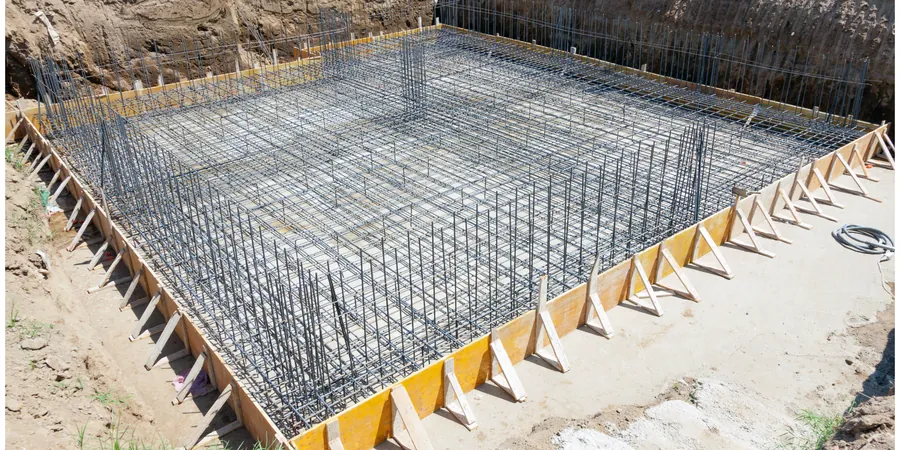
A common misstep we see with projects across Marion County involves engineers applying textbook mat foundation designs without accounting for the layered glacial till that defines Indianapolis geology. When a slab-on-grade is thickened into a rigid mat but the underlying preconsolidated clay lenses are ignored, differential settlement appears within the first three freeze-thaw cycles—cracking partition walls and jamming doors in newly finished warehouses. The problem compounds when groundwater perched in sand stringers saturates the bearing stratum during spring rains, reducing allowable bearing pressure precisely when the structure is most vulnerable. A proper raft foundation design must reconcile the stiff upper till with the softer, overconsolidated lower layers that dominate the White River valley, and that demands site-specific geotechnical input before a single reinforcement bar is detailed. For projects near Eagle Creek or the downtown canal district, we often integrate findings from in-situ permeability testing to confirm drainage characteristics that influence long-term mat performance under fluctuating water levels.
In Indianapolis glacial till, a mat foundation isn't just a thickened slab—it's a structural bridge over compressible layers that demand site-specific subgrade reaction modeling.
Methodology and scope
Local considerations
One observation that comes up repeatedly during site walks in Indianapolis is the presence of old agricultural drain tiles and undocumented fill pockets, especially on lots that transitioned from farmland to commercial use after the 1970s. A mat foundation might be designed for a uniform 6 ksf bearing stratum, but if a buried tile line has been slowly piping fines for thirty years, a void or loosened zone sits right where the northeast corner of the mat bears. The resulting uneven support induces bending moments that the reinforcement cage wasn't detailed to handle, and the fix involves costly pressure grouting after the slab has already been poured. Beyond man-made anomalies, the natural variability of the till—cobble-rich zones adjacent to clay-dominated zones—creates differential stiffness that must be accounted for in the finite element model. We've also observed that mat foundations on sites near Fall Creek and Pleasant Run are subject to higher water table fluctuations than FEMA maps suggest, making underslab drainage and vapor barrier detailing critical for moisture-sensitive occupancies.
Explanatory video
Applicable standards
IBC 2021 (Chapter 18 – Soils and Foundations), ASCE 7-22 (Minimum Design Loads), ACI 360R-10 (Guide to Design of Slabs-on-Ground) and ACI 336.2R (Suggested Analysis and Design Procedures for Combined Footings and Mats), ASTM D1586 (Standard Test Method for Standard Penetration Test), ASTM D2487 (Classification of Soils for Engineering Purposes)
Associated technical services
Full Mat Foundation Analysis & Design
Finite element modeling of raft foundations using modulus of subgrade reaction calibrated to site-specific stratigraphy, including reinforcement detailing, punching shear checks at columns, and construction joint layout for large industrial pads.
Geotechnical Site Characterization for Mat Design
Drilling, sampling, and in-situ testing program designed to define the till-silt interface, measure groundwater conditions, and provide the parameters needed for settlement analysis and bearing capacity verification under sustained dead plus live loads.
Typical parameters
Frequently asked questions
What is the typical cost range for a raft foundation design on a 20,000 sq ft commercial site in Indianapolis?
For a site of that scale in the Indianapolis area, the engineering design package—including geotechnical investigation, finite element modeling, and stamped construction drawings—typically falls between US$1,120 and US$4,610 depending on the complexity of the stratigraphy and the number of column load cases.
Why is a mat foundation often recommended over isolated footings in Indianapolis glacial till?
The glacial till across Indianapolis contains scattered cobbles, sand lenses, and preconsolidated clay seams that create variable bearing conditions over short distances. A mat foundation distributes column loads across a much larger area, smoothing out these differential stiffness zones and keeping total and differential settlements within tolerable limits—something isolated footings cannot achieve when the subgrade modulus varies by a factor of three across the building footprint.
How does frost depth in central Indiana affect mat foundation design?
Indianapolis sits in climate zone 4A, and the prescribed frost depth for Marion County is 36 inches per the Indiana Building Code. A mat foundation must either be placed below this depth or be protected by rigid perimeter insulation in accordance with ASCE 32. Most of our designs place the bottom of the mat at 36 to 42 inches below finished grade, which also positions the bearing surface below the active moisture fluctuation zone that can soften the upper till.