Indianapolis sits atop a complex glacial terrain shaped by the Wisconsin Episode, where thick sequences of till, outwash sand, and lacustrine clay conceal the bedrock at depths that vary dramatically across Marion County. This legacy of Pleistocene deposition means that two building lots separated by half a mile can exhibit fundamentally different dynamic soil behavior during an earthquake. When the 2024 IBC and ASCE 7-22 require a Site Class determination for new construction, the MASW method provides a non-invasive way to measure shear wave velocity directly from the surface, avoiding the cost and disruption of deep borings in congested urban corridors. Our team routinely deploys 24-channel geophone spreads along downtown Indianapolis right-of-ways, combining active-source and passive-source recordings to resolve velocity profiles to depths exceeding 30 meters even where cultural noise from I-65 and the Monon Trail complicates signal processing.
A defensible VS30 value from MASW eliminates the default Site Class D penalty, often reducing seismic design forces by 15 to 25 percent on stiffer Indianapolis till sites.
Methodology and scope
Local considerations
The interlayered nature of Indianapolis glacial deposits presents a specific hazard: velocity inversions where a stiff clay crust overlies softer saturated silt or sand, producing a VS30 that overestimates the site's true stiffness. This condition is common in the Eagle Creek watershed and along the buried pre-glacial Teays River valley, where deep paleochannels filled with organic silt and loose sand can go undetected by conventional refraction surveys. A MASW survey that relies solely on active-source hammer impacts may miss these low-velocity zones below 20 meters because the Rayleigh wave energy at those frequencies is insufficient without a passive-source supplement. Our field protocol always includes ambient noise recording with a circular or L-shaped array to extract the longer-wavelength portion of the dispersion curve, ensuring that the inversion resolves velocity structure through the full 100-foot depth required by the IBC. Without this step, a project near Fall Creek could be mistakenly classified as Site Class C when the true condition is a borderline Class E profile requiring a site-specific response analysis.
Applicable standards
ASCE 7-22 Minimum Design Loads and Associated Criteria for Buildings and Other Structures, IBC 2024 Section 1613 Earthquake Loads – Site Classification, ASTM D4428/D4428M-14 Standard Test Methods for Crosshole Seismic Testing (adapted for surface wave correlation), NEHRP Recommended Seismic Provisions for New Buildings and Other Structures (FEMA P-2082)
Associated technical services
Standard VS30 Site Classification
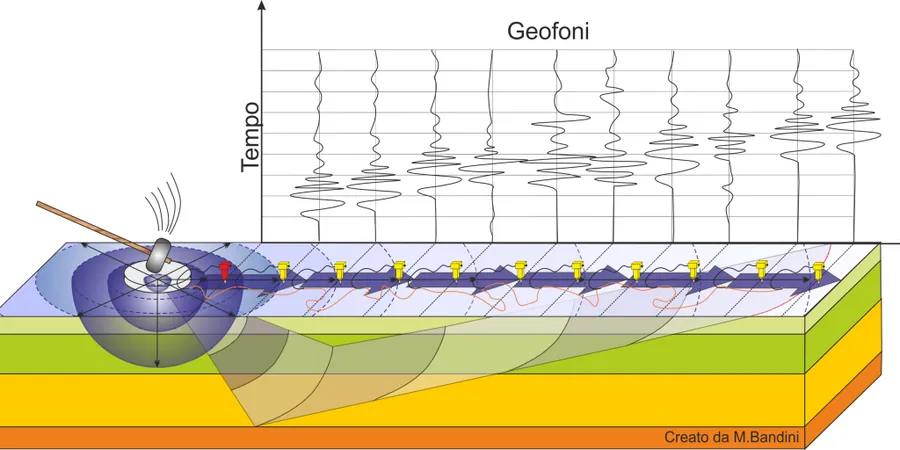
Active-source MASW with a 24-channel array and 8-kg sledgehammer source, processed through f-k dispersion analysis and damped least-squares inversion. Delivers a single VS30 value and IBC Site Class letter suitable for plan check submittal in Marion County.
Passive-Source Deep Profiling (MASW + MAM)
Combined active and passive (Microtremor Array Method) survey using ambient cultural and natural noise to extend the Vs profile beyond 30 meters. Recommended for tall buildings, critical facilities, or sites where the bedrock interface is deeper than 100 feet.
2D Shear Wave Velocity Cross-Sections
Multiple parallel MASW lines gridded across a site to map lateral velocity variations, identify buried paleochannels, and delineate the extent of soft zones. Used for seismic microzonation studies and large-footprint structures where 1D classification is insufficient.
Typical parameters
Frequently asked questions
How long does a typical MASW survey take on an Indianapolis site, and what access is required?
A single-line active-source MASW survey for VS30 determination typically requires two to three hours of field time, including array layout, data acquisition, and demobilization. The 24-channel spread needs a clear linear corridor approximately 150 feet long and 10 feet wide, free of overhead obstructions and heavy vehicle traffic during recording. We can work within parking lots, closed street lanes, and vacant lots; asphalt or concrete pavement does not interfere with the measurement provided we achieve adequate geophone coupling.
What does MASW testing cost for a typical commercial building project in Indianapolis?
For a standard single-line active-source MASW survey with VS30 reporting, project costs in the Indianapolis area generally range from US$1,770 to US$3,480 depending on the number of lines, site accessibility, and whether passive-source supplements are required to meet depth targets. A site with limited access requiring traffic control or night work will fall toward the upper end of that range. We provide a fixed-price proposal after reviewing the site plan and understanding the structural engineer's seismic design requirements.
Can MASW completely replace SPT borings for site classification in Indianapolis?
MASW provides the shear wave velocity profile needed for IBC Site Class determination, but it does not replace borings for soil sampling, groundwater measurement, or bearing capacity analysis. The most solid approach combines MASW with at least one borehole or test pit to confirm stratigraphy and index properties, allowing the geotechnical engineer to calibrate the velocity model against known soil types and select appropriate design parameters for foundation design.